Showing posts with label pope. Show all posts

Wednesday, March 13, 2013

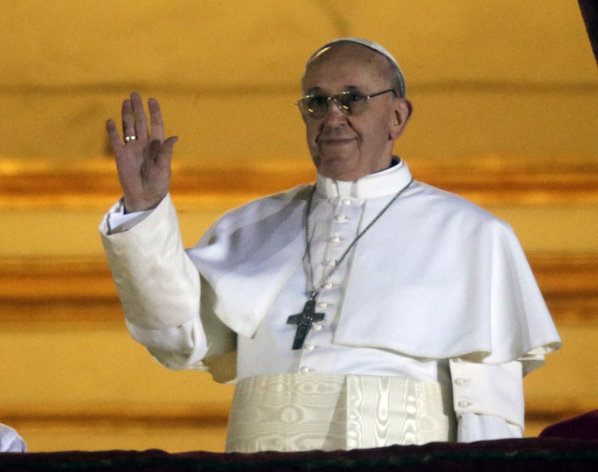
Pope Francis: a Few Facts and Quotes


Biographical Data

  • Born: Dec. 17, 1936, in Buenos Aires, Argentina.
  • One of five children of an Italian immigrant and railway worker.
  • Originally planned to be chemist.
  • Ordained a Jesuit priest on Dec. 13, 1969.
  • Taught literature, psychology, and philosophy
  • Served as Jesuit provincial in Argentina from 1973-1979
  • Ordained titular bishop of Auca and auxiliary of Buenos Aires on June 27, 1992.
  • Became archbishop of Buenos Aires on Feb. 28, 1998.
  • Received title ordinary for the Eastern-rite faithful in Argentina who lack an ordinary in their own rite on Nov. 30, 1998.
  • Proclaimed cardinal by Pope John Paul II on Feb. 21, 2001.
  • Pope Francis on March 13, 2013


A Few Facts
  • Never lived in the ornate church mansion in Buenos Aires, preferring a simple bed in a downtown room heated by a small stove. For years, he took public transportation around the city.
  • Speaks Spanish, Italian, German and some English
  • Had a lung removed due to infection when he was a teenager.
  • Reportedly received the second-most votes after Joseph Ratzinger in the 2005 papal election.

In His Words


"We need to avoid the spiritual sickness of a Church that is wrapped up in its own world: when a Church becomes like this, it grows sick. It is true that going out onto the street implies the risk of accidents happening, as they would to any ordinary man or woman. But is the Church stays wrapped up in itself, it will age. And if I had to choose between a wounded Church that goes out onto the streets and a sick withdrawn Church, I would definitely choose the first one.”

(Vatican Insider 2/24/2012 http://vaticaninsider.lastampa.it/en/inquiries-and-interviews/detail/articolo/america-latina-latin-america-america-latina-12945/)


"Our certainties can become a wall, a jail that imprisons the Holy Spirit. Those who isolate their conscience from the path of the people of God don’t know the joy of the Holy Spirit that sustains hope. That is the risk run by the isolated conscience. Of those who from the closed world of their Tarsis complain about everything or, feeling their identity threatened, launch themselves into battles only in the end to be still more self-concerned and self-referential."

(Interview with Cardinal Jorge Mario Bergoglio by Sefania Falasca 30 Days (11), 2007 http://www.30giorni.it/articoli_id_16457_l3.htm)


Monday, February 11, 2013

A Pope Resigns

Catholics all over the world are shocked by the news that Pope Benedict XVI will resign on February 28. For my non-Catholic friends and readers who have asked me what this all means, I'll try to give a little context and explanation.

First, the reason the Pope has given for his resignation is his age and increasing ill health. While people are fond of speculation and of scouring for ulterior motives, Pope Benedict has been looking increasingly frail over the past months. There is no reason to think that his age and health were not the motivating factors in this decision. In Light of the World: The Pope, the Church and the Signs of the Times, author Peter Seewald quotes Benedict as saying, "If a pope clearly realizes that he is no longer physically, psychologically and spiritually capable of handling the duties of his office, then he has a right and, under some circumstances, also an obligation to resign.”

Second, because no pope has resigned for the past 600 years, there isn't really a protocol for it. However, after the death of a pope, the conclave or council of Cardinals, who elect the new pope meet as quickly as possible. A new pope is generally elected within two to three weeks after the death of the old one. All reports say that the mechanics for putting the conclave together have been started and the election will undoubtedly be held almost immediately after the Feb. 28 resignation.

Third, the operations of the Vatican will slow or shut down during this transition period, but the lives of ordinary Catholics and Catholic churches will be largely uneffected. This is not to say that the pope doesn't exercise great influence over Catholics throughout the world, but merely that the everyday activities on the parish and individual level will go on as usual.

Fourth, there are speculations as to whom the new pope might be, but unlike an election to govern a country, a person cannot declare his candidacy nor can he outwardly campaign for the position. What happens in the corridors and behind the locked doors of the conclave is undoubtedly subject to many different pressures and influences, but in the end, Catholics believe that the Cardinals who elect the new Pope will be governed by the Holy Spirit. He may be one of the so-called leading candidates, but then again, he may not.

Fifth, Pope Benedict's new title isn't clear, but he may go back to being Cardinal Ratzinger, with the added title of "bishop emeritus of Rome," since the pope is technically the Bishop of Rome. He is expected to live a monastic life at the Vatican for his remaining years.

Sixth, Benedict will not be part of the election of the new pope because of his age, nor will he have any duties regarding the governing or guidance of the church after his resignation. It isn't like a former President who goes about on political missions. Benedict will probably spend his time reading and writing like the scholar he is. And playing the piano and perhaps enjoying the company of his cat.

Finally, there had been rumors that he might resign and he has had an unusual devotion to Pope St. Celestine V who abdicated the papacy in 1294, one of only a handful of popes who have done so. Benedict has visited Celestine's tomb twice during his papacy, which might have been a clue as to his thoughts.

As we get closer to the election of the new pope, I'll put up some information on that process. In the meantime, if you have questions, please leave them in the comments.