Friday, January 20, 2012

Aligning the Fulcrum

My son’s best friend’s older brother was a very precocious child and some of the things that he said would astonish me. When he was about 6, he informed me that I shouldn’t be letting my son and his brother play on a make-shift teeter-totter because “the fulcrum wasn’t centered.” He was correct; it wasn’t centered, but because I was older and a bit wiser, I knew that it didn’t have to be precisely balanced to be safe.

I often think about that when I consider finding the balance between work, personal, and family. It isn’t always a matter of having the fulcrum perfectly aligned, but it is important to find a safe balance.

Of course, that sounds very good when you read it, but it’s much harder in real life. People and projects have a way of taking as much time and energy as you are willing to give them. And the squeaky wheel really does get the grease a lot of the time.

Here are some the questions I've been asking myself this January:

Work: Can I separate your home life from my work?  Do I spend all my time either at work or thinking about work? Or conversely, do I try to get by doing as little as possible and cut as many corners as possible?

Personal: We are taught to be self-sacrificing, but sometimes we forget that we have to have something to sacrifice. Even Jesus went off by himself or with friends for renewal. He wasn’t always at everyone’s beck and call. Do you take time every day for myself? Even if it’s reading the paper with a cup of coffee or spending an extra 2 minutes in the shower, it’s important to give myself permission to have a slice of the day.

Family: This is a tough one for most of us because it never seems like we are giving our families enough time or enough quality time. I really struggle with this because my mother is in hospice and while she is slowly making her journey to the end of life, it is a slow journey. Nevertheless, I often fell that I should be with her 24/7, even though that simply isn't possible.
I wish I could offer you a neat formula for achieving these balances, but like the off-center fulcrum that I knew was still workable, finding that balance is something you have to do for yourself. 

Just like I have to do.

Thursday, January 19, 2012

Catching Healing

I came home last night to a cold house, two very hungry cats (who have continual access to dry food, but really only consider wet food worth eating) and a massive allergy attack.  At the time I wasn't quite sure if I was coming down with a cold, since I had the proverbial chills/fever/runny nose or just a very nasty allergy from something.

I had several things I had to do, like feed the beasts and cook some chicken breasts before they spoiled, so I wasn't able to head immediately to bed.  When I finally got upstairs, I was downright sick.  No SICK!!  I curled up in bed, feeling perfectly miserable and feeling perfectly justified in my misery.

But somewhere in the middle of the night, 2 a.m. I think it was, I remembered what a good friend,best-selling author Lauraine Snelling always says, "Never say you are getting sick.  Say you are catching healing." So I told myself, "You are catching healing.  You are feeling better.  You are feeling fine."

I didn't feel particularly fine and I didn't feel particularly healthy.  But I clutched my box of kleenex, put the cool cloth on my head and the hot water bottle on my feet and went to sleep.

This morning, I feel somewhat better.
I am catching healing.

Wednesday, January 18, 2012

Patron Saint of my Year


Several people (forgive me if I don't name them all) recommended this Patron Saint Generator to me. Now I've spent a good deal of my career writing about saints and I have a few special favorites, but the idea of randomly being assigned a saint for the year appealed to both my hagiographic and my geek side.

So I'm writing this in one browser window as I get ready to click the button in another.

And the winner, er, patron is.....

St. Elizabeth Ann Seton

She is the patron against In-Law Problems; against the Death of Children; against the Death of Parents; People Ridiculed for Their Piety and widows.

I almost chuckled when her name came up because in my upcoming book I write about her struggle with finances and this past year has been a financial struggle for me, as it has for a lot of people.
One of the things I wrote about her was:

A final lesson from Elizabeth’s life might be categorized as a cross between a warning and an encouragement. Earlier we talked about how sometimes our suffering can be self-generated. Even saints aren’t immune from this. At least some of St. Elizabeth’s financial woes were created because she went against her own better judgment. When the doctor suggested a trip to Italy might help William’s failing health, Elizabeth had her doubts, but she sold all their possessions anyway. Had she not done so, had they not made the voyage, her life might not have had as many financial stresses. However, “we know that God causes all things to work together for good to those who love God, to those who are called according to his purpose” (Romans 8:28), and had she not made the voyage, she might never have converted, never have founded the Sisters of Charity and never have become a saint.
Her example can be a comfort to those of us who have made inopportune financial decisions; even in the midst of our trials and suffering, blessings can still emerge. We may have to endure the consequences and subsequent pain that results from our choices, but, in Elizabeth’s words, “We know certainly that our God calls us to a holy life. We know that he gives us every grace, every abundant grace; and though we are so weak of ourselves, this grace is able to carry us through every obstacle and difficulty."

Even finances.

Tuesday, January 17, 2012

Lessons of Loneliness Part Deux

Yesterday I talked about how, in this past year, I have become, inexplicably and unwantedly (Not sure that's a word, but it should be...) visited by the spectre of loneliness and its conjoined twin, fear. Since I wrote that article, an interesting thing has happened. Nefer, the ever clever escape artist, has been right at my side.  When I least expect it, he reaches out his paw and pats me on the cheek.  Just a little pat, no claws.  As if to say, "How can you be lonely when you have MEEEE????"  I have to admit that it makes me chuckle just a bit.  But it also makes me wonder just how sentient animals are.  Certainly they can be empathetic, as Nefer is proving.


On the other hand, Basti couldn't care less.  "Food?  You gonna give me wet food? Or do I have to keep searching in these darn bags for something yummy?"


 Havng said that, because I both try to learn lessons from the events of my life as well as be aware of the synchronicities, the little miracles, that happen, I want to share one more thing from the past 24 hours.

During the GSA (Great Sewage Adventure), I had to dismantle a bookcase that I thought contained mostly lives of the saints and books on writing. (I don't know about you, but I don't cull my bookshelves nearly often enough and so sometimes there are books lurking that I don't know I have.) The books were stacked on a sofa and I decided that perhaps I could use the sofa to actually sit on, so I began putting the books back on the shelves.

As I did, I found a slender, brown book that I remembered from my childhood.  I don't remember my mother reading it, but since the copyright is 1954, it had to be hers.  I sort of vaguely recalled reading parts of it when I was in my 20s and going through a rough patch, but I had forgotten about it.  Now here it was again--My Daily Bread by Anthony Paone, S.J. Apparently it has been in print all these years and I just happen to own a first edition. (Woo Hoo!)

My Daily Bread is a set of daily readings on various topics intended to inspire and guide one in listening to and following the words of the Christ. It's divided into several sections such as Conversion, After Conversion, Temptation and Bad Habits.  Each section consists of a meditation written in the first person as if Christ were speaking to you, a brief reflection and a prayer.

The ribbon bookmark was still in place, so I decided to open to that section and see what it had to say.  I was a little surprised, but not completely, to see that it was on fear, loneliness's conjoined twin. In part it read: (Many) do not think with their intelligence, but with their feelings...they are slaves of their fears...." The prayer of the day added, "Let me not offend you by a lack of confidence. I trust in you. I will do my best to remedy whatever difficulties arise, but whatever be the results of my efforts, I will accept them as your holy will."

Somehow the message from that little book from my past seems very appropriate advice for my future.

Monday, January 16, 2012

Learning Lessons of Loneliness

I've never felt lonely.  Growing up as an only child in the country in Montana, I suppose I could have felt alone, but I never did.  I never felt lonely, even after my divorce and my son's going away to college.  I never minded going out to eat alone, seeing a movie alone, going to the theater, shopping, walking, traveling alone.

But in this past year, my year of debridement, I became acutely and painfully lonely. The spectre didn't just knock on the door.  It broke the door down, tossed its bags on the floor and camped out. I was continually aware that I was alone.  Day and night. Every day and every night.

And, concomitant with loneliness, came its conjoined twin--fear.  Things I'd never thought about before became frightening.  For instance, going up in the attic. Should I have an accident, I might not be discovered for days, even weeks.  Making sure I had my cell phone with me at all times suddenly became paramount.  At least I could call 911!

Loneliness penetrated other areas as well. It became painful instead of pleasurable to go to a movie and sit in the dark by myself. Same for going out to eat or shopping.  And a hike alone in the wilderness held no appeal.  Even going to church brought no comfort.  I would go Sunday after Sunday and not have one single soul speak to me.  Eventually, it became easier to just leave early rather than be constantly reminded of just how alone I was.

I have done all the "right" things to combat loneliness--become involved in activities, reach other to others, make connections, plan ahead.  But underneath it all is still the constant awareness that I am alone...and lonely.


Now this is the place where I'm supposed to tell you about some incredible turn of events, perhaps talk about how I realized that I was never alone in the presence of God. How I was overcome by the light. Blah Blah Blah. The fact is: No  miracle has occurred.  I'm not suddenly dancing in the joy of the presence of the Lord. For the first time in my life, my default position is to be lonely.

However, what has happened is that I am willing to sit and observe the loneliness. Recognize her for what she is.  Let her simply be a part of my life. Give her a name. Let her sit on my chair and drink my tea. Ask her why she has come. Listen for her answer.

Apparently there are still some lessons I need to learn...and loneliness is one of my teachers. I just hope and pray that I can learn her lesson and incorporate her wisdom into my life soon.

Sunday, January 15, 2012

I am Grateful--Sunday Gratitude

What are you grateful for this Sunday?

I am grateful:
1.  For a flock of robins that hopped and pranced on my lawn, looking for earthworms.  I counted at least six, the most I've ever seen at one time.


 2.  For pumpkin spice latte.


3.  For a bargain matinee price to see the movie Hugo which, incidentally, is a mystical and magical meander through time, both literally and figuratively.  Well worth seeing.


4. For Words with Friends and especially for having finally won a round!


5. For being on the right side of the winter solstice, with the days getting longer minute by minute.


6. For a pellet stove when the temperature is below freezing


 7. For Nefer and Basti, even though they do drive me crazy at times.


8.  For chocolate.  Some things are always on the list.


9.  For Bach Flower Remedies. (I'll have to write about them soon.)


10.  For the promise of a new day, no matter how many struggles there have been in this one.

Saturday, January 14, 2012

Criticizing Saints and John Carter of Mars

I just saw a trailer for the upcoming Disney movie on John Carter of Mars, which excited me to no end.  I totally loved the original novels, which were my introduction to classic Fantasy Sci Fi. I've been waiting for years for the books to be adapted to film. I think there was some horrible, cheezy version, but they really needed modern CG to make Barsoom come alive. Incidentally, the original novels were written by Edgar Rice Burroughs of Tarzan fame.

While the plot and the characters of the books held up extremely well, even after 100 years (They were first published in 1912.), certain underlying societal attitudes fare less well. Some of the language, especially in reference to Native Americans (you have to read the books to figure out how Native Americans figure into a story about Mars!), is racist by today's standards. And, although the books do a remarkable job of seeing beyond skin color for their time, there is a subtle undercurrent of superiority that still flows through the ink (or electronic pulses, since I reread them on my Kindle).

Which brings me to saints.  In particular, the criticism of saints from our modern vantage. A couple of days ago, I quoted a bit from my upcoming book on another way to view Mother Teresa's apparent lack of modern painkillers in his homes for the dying, saying that one has to understand where she comes from with regard to suffering before you judge too harshly.

This is a problem with many saints.  A lot of them would not fare well in today's world. For instance, St. Rose of Lima would probably be under psychiatric care for her propensity to self-mutilate. Others were accepting of norms we reject today, like slavery. Still others were so single-minded in their pursuit of the Divine, they were socially inept and even rude at times (the Cure of Ars, comes to mind.)
As we look at these people through our own lenses, we can be tempted to decide that they weren't really all that holy.  But we have to remember that they were living in their own time and place. We need to judge them, not by our standards, but by the standards they judged themselves.

Just as the John Carter stories need to be judged by the standards of the turn of the last century and appreciated for what they are, not what they should be today.

Friday, January 13, 2012

The Wonder of Facebook

I think everyone has moments when they think "It wasn't like that when I was a kid..."  With the world changing as quickly as it has, even people born 20 years ago can say it and mean it. 

One of my favorite changes is social networking.  I really love Facebook, not just because it allows me to pretend I'm being productive when all I'm really doing is reading other people's walls, but because it affords a way of connecting that was never available before.

Through Facebook, I've found two people I've wondered about since I was in high school.  I had lost track of one when we were freshmen and her family moved from California to the East coast.  Another I never saw again after graduation.  But both flickered in and out of my mind over the years and with the help of Facebook, I was able to reconnect.  It felt almost like a miracle.

And through Facebook, I've been able to dialog with people I'd probably never have a chance to meet in my "real" life, like authors Anne Rice and Fr. James Martin, as well as people from all over the world. Because of Facebook, I was able to get real time pictures of the revolution in Egypt when it happened, for instance.

The reason I'm mentioning this today is because of my 2012 commitment to becoming more aware of things to be grateful for in my life.  Who would have known that a social network site on the internet would become such a major source of thanks? 

But it has.

And it is.

Thursday, January 12, 2012

The Legacy of Mother Teresa

Recently on Facebook, noted author Anne Rice linked a  Forbes article about Mother Teresa and allegations of less than sterling care provided by her houses and sisters.  Thiis controversy really isn't new; The medical journal Lancet wrote something similar several years ago. While I haven't devoted time or energy to determining the validity of these pieces, I did write a chapter on Mother Teresa in my upcoming book Facing Adversity with Grace. (I've also written  a book of her quotes, linked to bible verses called Listening to God with Mother Teresa.)

In the upcoming book on Adversity, I wrote:


As we look at the life of Mother Teresa, there something else about her attitude toward suffering that we need to examine, a feature that has generated some criticism from her detractors and that is her so-called “theology of suffering.” It was widely claimed in the medical press that because she believed ‘the most beautiful gift for a person (is) that he can participate in the sufferings of Christ,”[1] she did not do as much as she could to procure medical treatment for those in her Homes for the Dying and even subjected the patients to such practices as cold baths and the withholding of pain medication.
Whether or not they are true, these accusations remind us that saints are recognized for their passionate love of God, not for their infallibility. In looking at Mother Teresa’s life and the mental suffering she experienced, it isn’t difficult to see why she might have developed a particular theology that almost relishes suffering. She knew that she was offering her entire life to God as a gift and she also knew that she was in great mental anguish for most of it. She had to also have been aware that her “dark night” was like that of John of the Cross who, as an antidote to the pain, recommended, “Do the most difficult, the harshest, the less pleasant, the unconsoling, the lowest and most despised, want nothing, look for the worst”[2] for she clearly modeled her life and that of her sisters on that credo.
The problem is that one of the greatest temptations for all of us to assume that our personal experience is universal. We tend to generalize from our specific experiences. This may be what happened with Mother Teresa. Since she experienced her suffering as a blessing, it’s not hard to imagine she believed that similar suffering it would bring blessings to everyone. Because she was able to transform her pain into a love offering to God, it’s not out of the question to think she might assume that would be equally true for everyone else.
From believing that suffering is a great gift that you can give to God, it’s a very small step to wanting to make sure that others have ample opportunity to give that same gift to God. Thus, Mother Teresa might well have had an aversion to painkillers and a desire to implement stringent self-disciplinary practices in order to insure that the people she served were given ample opportunities to offer up their pain just as she did.
Here is where we can use Mother Teresa, not so much as an example of what we should do, but as a caution against what we might be tempted to do. God deals with each of us as individuals, including the suffering that he allows in our lives. We should be wary of extrapolating our unique experience into a generality for all people. Mother Teresa was a remarkable icon of holiness for our time. But she was also human and subject to assuming that the way God dealt with her was the way he deals with all people. This is not to say that her desire to offer up suffering was bad. It isn’t. In fact, offering up pain is one of the major lessons we can learn from the saints. But it’s not our job to see that others have a chance to suffer in order to offer up that suffering. What that means on a practical level in our own families is that while we may undertake certain disciplines (such as rising early for prayer or fasting), it’s not our right to insist that our spouses or children share those disciplines. All suffering, both that allowed by God and that created by our own choices, is always unique to the individual. Because of that, we have no right to try to “help” others find ways to suffer. Rest assured, they will find ample opportunity on their own.


[1] http://www.mukto-mona.com/Articles/mother_teresa/sanal_ed.htm


Tuesday, January 10, 2012

Are We Ready for a President Mittens?


In the nation's first primary, Mitt Romney took New Hampshire. Rather he will be the GOP candidate or not is still a long ways off, but what's really essential to know is that 2% of voters nationwide think his first name is....

MITTENS!!

According a 60 Minutes/Vanity Fair poll, a 20 percent plurality of us thought that "Mitt" was his real name and not a glove-like nickname. 18 percent said "Mitchell"; 8 percent, Milton; and only 6 percent correctly said "Willard." But the most important stat from the survey is that somehow, in some way, 2 percent of real-life adult voting Americans believe that his name is "Mittens."
 AND....Another 2 percent thought his name was "Gromit." As in, apparently the cartoon characters  Wallace and Gromit.(Given the state of American politics, perhaps a cartoon isn't so far off after all.)

 
However, as the article points out, any of the above are better than the connotations associated with Newt Gingrich. Who was born Newton Leroy McPherson.  I'm not sure that Leroy is much better than Newt, to be honest.

(I think the lesson here is to be careful what you name your children.  Oh, and Mitt's real first name, Willard, is that of a horror film about a rat.  Perhaps he is better off with the image of nice, warm, fuzzy hand-coverings.)

Serious ponderings will resume tomorrow.

Coping with Fear

One of the unexpected effects of my last year was the decidedly unwelcome visitor of fear.  As in heart-pounding, mind-swirling panic.  As an adolescent, I had experienced panic attacks, and again, but I had, erroneously, assumed that they were part of the past. When the first one came, it was an old familiar and most unwanted guest.The only good part about it was that I knew what it was, so I didn't have the "second fear" that often accompanies the physical sensations.  I knew that it wasn't fatal, wasn't going to last forever and I even knew what steps to take to mitigate it.

However, fear still entered through the door, dropped its coat on my couch and sat down for a long visit.  In fact, it still pops up now and then, as if to remind me that it hasn't quite gone south for the winter.

I've researched fear and panic from psychological, physical, mental and spiritual perspectives and I still don't completely understand what causes it.  I understand the biological changes, the adrenalin surge and all that.  I comprehend the erroneous thinking patterns that create F(alse) E(evidence)A(pppearing)R(eal). And I get that fear is the antithesis of love. But I'm still not quite sure why it would surge back at this time in my life. Or, more precisely, why I would be allowing it to return.

The only thing I can figure out is that, in its presence, I am being forced to take a long, hard look at my life. Fear is like a scalpel, laying bare what was under the surface. It is making me examine what I was doing and face the fact that a lot of it wasn't working.  Oh, it appeared to be working and I had convinced myself and a lot of other people that it was working, but under the razor-edge of fear, I am having to face the fact that things have to change.

I have to change.

Now I'm still working on what those changes are and how to bring them into my life, but along the way I have figured out a few things about how to use fear and panic to facilitate change and not let them totally use me. I hope that perhaps my experience will help you, if you find these unwanted guests shoving their way into your life.

Keep Active
If you let fear and panic have their way, they will take over your entire life. Especially if you just sit around. When I feel them creeping up, I do something, even if it's just the dishes. A little activity goes a long way.

Don't Isolate
The more alone and isolate you are, the more fear and panic can grow. So force yourself to get out. Make a phone call. Visit a friend. Confide in someone you trust. If necessary, get professional help. Just don't let fear and panic be your only companions.

Find a Spiritual Practice that Works for You
For me, returning to some of the prayers and rituals of my Catholic childhood has provided a grounding.  I don't know what will work for you, but I do know that reaching out for help from God has been a life-saver.  Just believing that I am not alone in this, that there is a light on the other side and that I can find Divine guidance has given me the courage I need to get through the day.

Accept What Is
This is the toughest for me, but it is absolutely vital. Much of what creates my fear and panic is an unwillingness to accept the reality of the moment. I don't want my mother to be in hospice.  I don't want to be looking for work. I don't want to be struggling financially.  I don't want to be alone.  But right now, the reality is that my mother is in hospice.  I am looking for work.  I do have financial issues.  I am alone.  The reality of the moment doesn't mean that the situation is permanent, but if I am to make changes, I have to accept what is right now.  

Believe in Positive Change
I truly believe that we get what we believe in.  As long as I believe that things are bad and going to get worse, that's what will happen. So each day, sometimes many times a day, I remind myself that each little step I take toward a more positive future is helping create that future.  And with each positive change, a little bit of the fear gets replaced by a little bit of hope.


Monday, January 09, 2012

Angry Birds

Most of the time I tend to be fairly serious, so I decided to lighten up a bit and try playing Angry Birds.

I hate to admit it, but I don't get the game.  No, I understand that it's based on laws of physics and I comprehend the principles involved in judging trajectories and impact velocity.  What I just don't get is why tossing irritated birds at green pigs is fun.

So what is the appeal?


Elder Care and an Anniversary

I've been responsible for my mother for at least the past 12 years, with a couple of less-intense years before that.  The care has steadily increased, as is always the case with eldercare, reaching what I thought was maximum velocity a year ago.

She was in an assisted living facility at the time.  I got the call about 2 am.  She had fallen and was taken by ambulance to the E.R.  I drove through the deserted streets, that  much I remember, and I know I had to have parked somewhere and gotten myself into the E.R., but that's all a blur.  As are the next several days, with medical tests and decisions battering me from all directions.

She had broken both legs and, at 91, two doctors told me it would be a "terminal event" and wanted to know if I merely wanted her heavily sedated with morphine for the few days or weeks it would take for her to "pass."  Knowing my mother, I was 100% sure that she would survive the surgery and go on to live for a long time.  Seeing as how we are now approaching the one year anniversary of her fall, I feel fairly vindicated at the decision to have surgery and complete rehabilitation. 

Wants vs Needs

The year of her recovery has been, however, a major contributing factor to my year of debridement. I have always had a difficult relationship with my mother.  Not that we ever argued.  Or that there was anything visible on the surface.  I simply did whatever she wanted whenever she wanted my entire life.  There was never any conflict, because she got her way in all things.  Now, however, I couldn't give her what she wanted--which was a totally pain-free recovery with me at her side 24/7.  And in realizing that I couldn't give her her wants, I became aware of my own needs. Actually, for the first time, I realized that I did have needs and they were just as important as everyone else's wants.

You'd think that by age I'd have learned that lesson, but I was raised with an incredibly strong mother who doled out equal doses of parental and Catholic guilt, heavily seasoned with Catholic teaching on the need for self-sacrifice.  So it had to have been a God-thing, that just as I was becoming aware of my needs, I was writing a book on Facing Adversity with Grace, stories of saints who had to work through suffering.

Telling Myself Stories

I began the book just about the time she fell and I finished it just as she was leaving the nursing facility.  I think if I had written the book any other time, it would have been a far different book, because as much as I was telling the stories of Mother Teresa and St. Helena, I was also teaching myself lessons about what suffering is, what it isn't and how it can either shape or destroy our lives. I just reread some of the passages and thought, "Hmmm...how is it that you knew these lessons but weren't really applying them?"

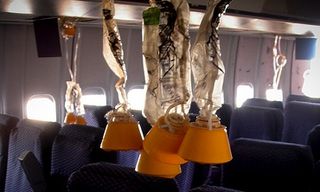
So now, on this mid-January morning, my mother is still alive and doing remarkably well.  We are coming up on the anniversary of her fall, which is also an anniversary for--the anniversary of the day that I began to learn that self-sacrifice isn't self-immolation and that taking care of one's own needs isn't selfish--it's essential.  Afterall, we have to have our own oxygen masks in place before we can assist others.  For too many years, I tried to help others with their masks while holding my breath. And, as I said a couple of days ago, one of the major lessons I learned was that breathing is important to life!


Sunday, January 08, 2012

Sunday Gratitude

I've decided that on Sundays I'm going to simply list 10 things that I am grateful for during the past week. (Unless something really interesting happens and I feel compelled to write about it.) 

So here goes:
1. A room of my own, as Virginia Wolfe said.  A friend of mine gave me free use of an office in his building to start the new year.  I'm hoping the separation of home and work, much like church and state, will help shift energy.  I'm anxious to see what new doors creatively and emotionally can open. 
2. Those who follow me on Facebook will know that over Christmas we had the GSD (Great Sewer Disaster).  This week the soggy carpet was removed and new flooring put down.
3. I got to attend a two-year-old's birthday party. It's good to be reminded just how splendid balloons are.
4. A friend brought me a tuna fish sandwich for lunch.  Sometimes it's the small things that make a difference.
5. There was sunshine a few days.  Here in Oregon in winter, one doesn't take seeing the sun for granted.
6. My African violet bloomed.  Since I have a black thumb, any plant that survives deserves a prize. Blooming is above and beyond the call.
7.  I discovered Words with Friends.  I've never been good at Scrabble and I have yet to win a game of WWF, but I'm enjoying the processing of regular loss.
8. I had one stick of rose incense left.  It's my favorite, so to mark Sunday, I'm letting its fragrance fill the room.
9. I remembered to charge my cell phone before it totally ran out of energy.
10. 2011 is over.  It's a new year.  I am grateful to have made it through.

Saturday, January 07, 2012

The Top 3 Things I Learned in 2011

Okay, I'll be honest. 2011 sucked for me.  Big time.  As I said when I called it my Year in the Burn Unit, it was spent careening from one unpleasant experience to another.  However, as I try to make sense of it, three lessons emerge.

Lesson Number One:  Breathing is Important
As the year wore on, I found myself literally and figuratively holding my breath, waiting for the next bad thing to happen. This was not a good thing.  For one, breathing is fairly essential to life.  The brain needs oxygen to survive.  Without it, one's thinking gets a bit screwy.  But more than that, when you hold your breath figuratively, you fail to live in the present moment. You are either dwelling in the past or attempting to live in the future.  In any event, you aren't fully present in the present. And the only place you can actually live in is the now. So in this year, I am focused on trying to remember to keep breathing, no matter what happens.

Lesson Number Two:  One Moment at a Time
This is definitely related to Lesson Number One.  When things were really tough I realized that if I just took things one minute at a time, I could get through it.  Sometimes I literally had to say to myself, "You are okay right now.  You are okay right now.  You are okay right now" to manage.  I learned that no matter what is happening, as long as I am still alive, I am okay in this precise exact moment.  Now there may be an individual moment sometime in my future when I won't be okay, but so far I haven't found it.  So even when I am feeling panicky or fearful or despairing, as long as I take a step inward and remember that I am okay at this minute minute, I really am okay.

Lesson Number Three:  I Can Control My Reaction
I suffered under the illusion that I could control things for many years.  This past year, I realized that I can't control squat.  Maybe even less than squat.  The only thing I can control is my reaction to what is happening.  And along with that, I finally figured out that I do have control over my reactions. They don't just happen without me. In fact, events themselves don't have any inherent goodness or badness attached to them (most of the time.  Genocide, murder, etc are a different category.)  For instance, if I spill coffee on my blouse in the morning, is that a bad thing? Only if I think it is so and allow it to ruin my day. It can be anything from a minor blip to a big honking deal...it's all in how I look at it and how I react to it. So after last year, I'm trying to be in control of my reactions and not let them control me.

Interestingly, in researching Facing Adversity with Grace, these lessons are some that I realized the saints applied to their own lives.  Saints aren't all that different from you and me in what happens to them.  The differences come because they have learned to live in the present (while considering, but not worrying about the future or trying to relive the past) and in controlling their reactions.  In the midst of everything that happens to them, they are able to make their reaction one of thanks IN and not FOR.

Which probably should be Lesson Number Four:  Remember to be Thankful IN all things. Maybe that's the most important lesson of all!


Thursday, January 05, 2012

Small Change(s) and Many Magi

I don't do change well.  People who know me say that I cling to the status quo until my fingers turn numb.  Now I don't think I do that...exactly...but I will admit that I don't approach change with anything resembling enthusiasm.

However, today, on Epiphany, there is one change that intrigues me.  In November, religion scholar and expert in ancient languages, Brent Landau Th.D, provided the first English translation of an ancient Syriac manuscript that was in the Vatican library about the Magi.

The manuscript, discovered in Turkey and written on vellum (a kind of parchment made of animal skin which I had a chance to see when I visited Turkey last fall), had languished in the Vatican since the 18th century.

What's interesting about the account is that instead of the traditional three Wise Men, the new research indicates that there might have been as many as 40 and instead of coming from some nearby Middle Eastern country, they may have journeyed as far as from China.

The USA Today story on the topic reports:

Landau's book, Revelation of the Magi: The Lost Tale of the Wise Men's Journey to Bethlehem (HarperOne) describes the Magi as an ancient mystical sect descended from Seth, the pious and virtuous third son of Adam and Eve. From Seth they inherited a prophecy of "a star of indescribable brightness" someday appearing and "heralding the birth of God in human form." This same star had initially hovered over the Tree of Life in the Garden of Eden.
Among the book's other revelations:
•The Magi are described as coming from a land called Shir, "located in the extreme east of the world, at the shore of the Great Ocean." In other ancient texts, Shir is referred to "as a place where silk comes from," says Landau, suggesting that the references were to China.
•In Syriac, the word Magi means "to pray in silence." Landau says it has no relationship to magicians or astrologers, sometimes cited in stories today.
•The text names 12 Magi, not three, while other parts of the text suggest that "a group the size of a small army" traveled to Bethlehem, says Landau.
Gives a whole new slant on the Christmas story, doesn't it?

5 Ways to Practice Gratitude

One of the things I learned during this past year was that gratitude doesn't come naturally to me.  Perhaps just as some people are filled with the milk of human kindness, others are filled with the wine of gratitude, but I'm not.

However, I have discovered 5 ways to learn how to be more grateful each day.

1.  Be attentive
When I drift through life, not really paying attention to what's going on, I miss many of the small things that make up daily gratitudes.  For example, as I sit here this morning, the sun has emerged from hiding, something it does frequently in Oregon winters, and is illuminating the yard with gold.  If I didn't stop and look outside, I would have missed this moment for gratitude.  And trust me, it won't last long in Oregon, land of the grey drizzle.

2. Write it down
I always think that I'll remember from day to day, but once I go to bed, I promptly forget everything I might have been grateful for the day before.  I have to write down what I've noticed or it will evaporate forever.  So each night, before I turn off the light, I simply jot down two or three things in a simple journal.  Nothing fancy, no elaboration, just "Sunlight on the deck this morning" or "Call from a friend."

3. Think small
I don't always have big, huge, ginornous things to be grateful for each day and I doubt you do either. After all, we can only get our dream job, take a once-in-lifetime trip, fall in love now and then. However, every day has something in it that can create gratitude...as long as we are willing to think small.  A cup of coffee with just the right amount of cream.  Clothes fresh from the dryer.  (No trying to dry on a rack in front of the heater.) A cuddle with the cat.  If you shift your focus from the macro to the micro, there is always something to be grateful for.

4. Keep looking
There have been times when I honestly didn't think there was anything to be grateful for.  Those were the days when I didn't allow myself to go to sleep until I found one thing, even if it was just that I had survived another day.Through that process I learned that there is always something, no matter how minute, that I can be grateful for, even in the midst of the worst times.

5. Make a commitment
If you want to find things to be grateful for, you need to find things to be grateful for. In other words, you need to commit to making gratitude a part of your daily life. It's a little like brushing your teeth. You have to do it every day,


Wednesday, January 04, 2012

Thankful IN, not FOR

Yesterday I said that I felt 2011 was my year in a life burn unit. As I reflected, I realized that it was very much like having my entire life debrided of those things that weren't authentic, weren't on focus for my purpose in life.  I had spent many years, too many, putting aside and putting off those things that a small still voice had encouraged me to do.  Instead I did things that I thought were expected of me...and, to be honest, a lot of them were expected of me and a lot of them were actually good things to do.  But I had buried that little voice so deeply I could no longer even recognize it when it was shouting. So that's why I think I had to have my life debrided.  All the things I thought I could count on, that I had taken for granted (and not necessarily in a good way) had to be painfully scraped away until I was left, raw and bleeding emotionally and psychically. I learned what it felt like to stand on the brink of what used to be called a nervous breakdown, and it was not a place I would wish on anyone.
But somehow, through a combination of grace and friends and prayer, I have managed to step back from the edge.  It's still close, but not as close it was just a few months ago. I knew things were getting better when I finally sorted my socks.  Now that might not sound like a big thing, but for months I just stuffed the socks in a basket, and searched for pair or something that appeared to be pain-like when I needed socks.  When I actually took the time to find the mates and put them back in the drawer where they belonged, a mundane act if ever there was one, I realized that maybe things were improving. (No, this isn't my drawer, but I think I have that many socks.)

As I said, I'm still en pointe a lot of the time, but with the new year, I'm feeling the touch of "the thing with feathers That perches in the soul," as Emily Dickinson calls it. One of the things that has helped is to make a concerted effort to tell a friend about the abundances, the blessings that have occurred each day. Even when the day was at its worst, I knew that I had to find something to send her in an email, even if the something was as simple as "I made it through another day without feeling like panicking."

It wasn't always easy because, for a long time, most of my life to be honest, I misunderstood 1 Thessalonians 5:18 (in everything give thanks; for this is God's will for you in Christ Jesus).  I thought it meant that we were supposed to be happy about everything that happened.  Woo Hoo, I got a flat tire!  Yippee, I was just fired.  YES!! I've just gotten really sick.  YEAH God, this is so cool!

I couldn't understand how anyone was supposed to feel floods of joy and happiness resulting in an outpouring of thanksgiving when bad things were happening. In the course of writing about saints and adversity, I came to realize that even the saints weren't always tickled to death about bad things.  And I realized that I had been misreading the bible verse all these years.

We don't have to give thanks FOR all things...only IN all things.  Big difference. God doesn't expect us to be all starry-eyed with joy when life batters us with pain and suffering.  God would be sadistic and we'd be masochistic if that were the case.  What we are asked to do is to find the good in the bad, the blessing in the midst of the pain, the happiness in amongst the sorrow. It's sort of like seeing the flowers amid the weeds.  Or maybe seeing that the weeds themselves are flowers.

It isn't easy to do, but I've found it is possible. Take last year, for instance.  It began in January with the axle breaking on my car---while I was driving it.While I certainly didn't give thanks for the break or the repair or the inconvenience of it all, I am finally able to be thankful that I noticed something was wrong just as I was driving by the dealership repair shop.  I turned in and had they look at it right that moment.  Had I driven even a few more yards--or attempted to get on the freeway--I would have been in a serious accident with a high potential of injury or death.  So now, looking back, I can say that I found something to be thankful for in the midst of it all.

It's taken me some time to absorb the lessons, but as I wrote in the introduction to Facing Adversity with Grace:
I firmly and absolutely believe that God does not want us to suffer, but wants us to live abundant lives. While we all will experience some pain on our life journeys, becoming entrenched in suffering is not honoring God and it is not living abundantly. So my hope for you is that as you read how the saints used their suffering, you will discover, not just words of spiritual consolation, but genuine, practical measures that you can use in your daily life in order to eliminate unnecessary pain and to claim the abundant life God has promised each one of us. After all, this life in the “vale of tears” may not always be easy, but it is always good!
So what have you found to be thankful for IN this day?


And for your Nefer/Basti update, I think Basti is channeling Spiderman here. He is one determined cat. He promises me that when he comes down, he'll resume his Dispatches from the Front.  God save us all!!!


Tuesday, January 03, 2012

Debriding Life: A Burn Unit Kind of Year

As many of you know, 2011 was probably the worst year of my life.  As I was going over my daily planner in preparation for filing it away, I found myself mentally careening from one awful thing to the next.  I thought about composing a sort of anti-Christmas letter for the New Year since I didn't send out Christmas cards, but it was just too depressing and negative to recall all the horrid events.

However, some of the lowlights included having the axle break on my car as I was driving it, Nefer destroying my laptop, my mother falling and breaking both legs, killing my beloved cat Hati by hitting her with my car, financial problems, illness, a second fall for mother, more financial problems and lack of free-lance work, visit to the ER with chest pains, house repair issues, the new laptop from January having its hard drive crash totally in November and finally to cap off the year, massive sewage problems over Christmas.  Not to mention a few classic panic attacks in there...hence the visit to the ER.

This could just have been a series of unfortunate events a la Lemony Snicket, but there were so many this year wouldn't have been believable even as fiction.  So I concluded that there must be some reason behind them all, something that I was attracting into my life and that God was permitting.  In other words, I thought that the events might not all just be random, but there might actually be a purpose behind them.

As I reflected on my year, there were several times when I thought that death would be preferable to going on. But deep down, I knew that death really wasn't an option.  Not only would it be incredibly selfish and unfair to those who care about me to prematurely opt out of life, I had a deadline for a book on facing adversity with grace.  How would it look if someone who was trying to encourage people that suffering had meaning would give up on her own suffering.  Very bad form, indeed. (Incidentally, the amazon page has the first cover.  The new cover is much better and reflects the intent of the book much more clearly.)  So I trudged through the year, feeling a bit like Dave Berry, who thought that 2011 was the kind of year that makes an oil slick look good.


That's when the  image of a burn unit sprang to mind.  I know that in order for a burn victim to heal, the wounds must be painfully debrided, a process that is, apparently, among the most excruciating procedures in medicine. All the old, unhealthy tissue has to be cut, scraped or chemically removed in order for new, healthy tissue to grow.  Even with heavy-duty narcotics, the pain is almost unbearable.

And the really hard part is that the tissue that must be removed isn't necessarily infected.  However, its mere presence makes it harder for the body to fight infection and creates pockets where infection can develop. So all the tissue has to be removed in order for the person to recover.  It is literally a case of going through the pain or dying.

So, in order to try to make sense of what happened to me, I'm doing what all words-people do: write about it.  For the next few days, I'm going to talk about some of the things that happened and try to share whatever lesson I might have learned from it with you in the hopes that perhaps my journey might lend you some insight into whatever adversity you might be going through in your own lives.  Beginning tomorrow...there's only so much visiting adversity that I can face in a day.

One last thing--last year I followed the sad case of Fr. Corapi with what probably bordered on prurient interest. I just learned via Patrick Madrid that The BlackSheepDog has vanished from cyberspace.  With all the scandals the Catholic church has faced recently, I hope that this story has a happy and holy ending.


Monday, January 02, 2012

Touching History


I edit the Archaeology Audio News for the Archaeology Channel and one of the funner (yes, that's a word.  I may have just made it up, but it's now a word.) aspects is when we have the occasional story that deals with biblical archaeology. 

was likely used by Temple officials approving an object for ritual use — oil, perhaps, or an animal intended for sacrifice. Materials used by Temple priests had to meet stringent purity guidelines stipulated in detail in the Jewish legal text known as the Mishna, which also mention the use of seals as tokens by pilgrims. 

What makes this seemingly insignificant piece of play so amazing is that it is one of the very few objects that can be traced to the Temple that Jesus attended since the Temple was thoroughly destroyed by the Romans in 70 AD. 

In another life, I would have been an archaeologist.  I love seeing artifacts that link us concretely and really (in the sense of being real) to the past. Knowing that someone who lived and loved and fear and prayed and laughed and ate and did all the things that we do made this little seal 2000 years ago compresses history into something I can actually grasp.

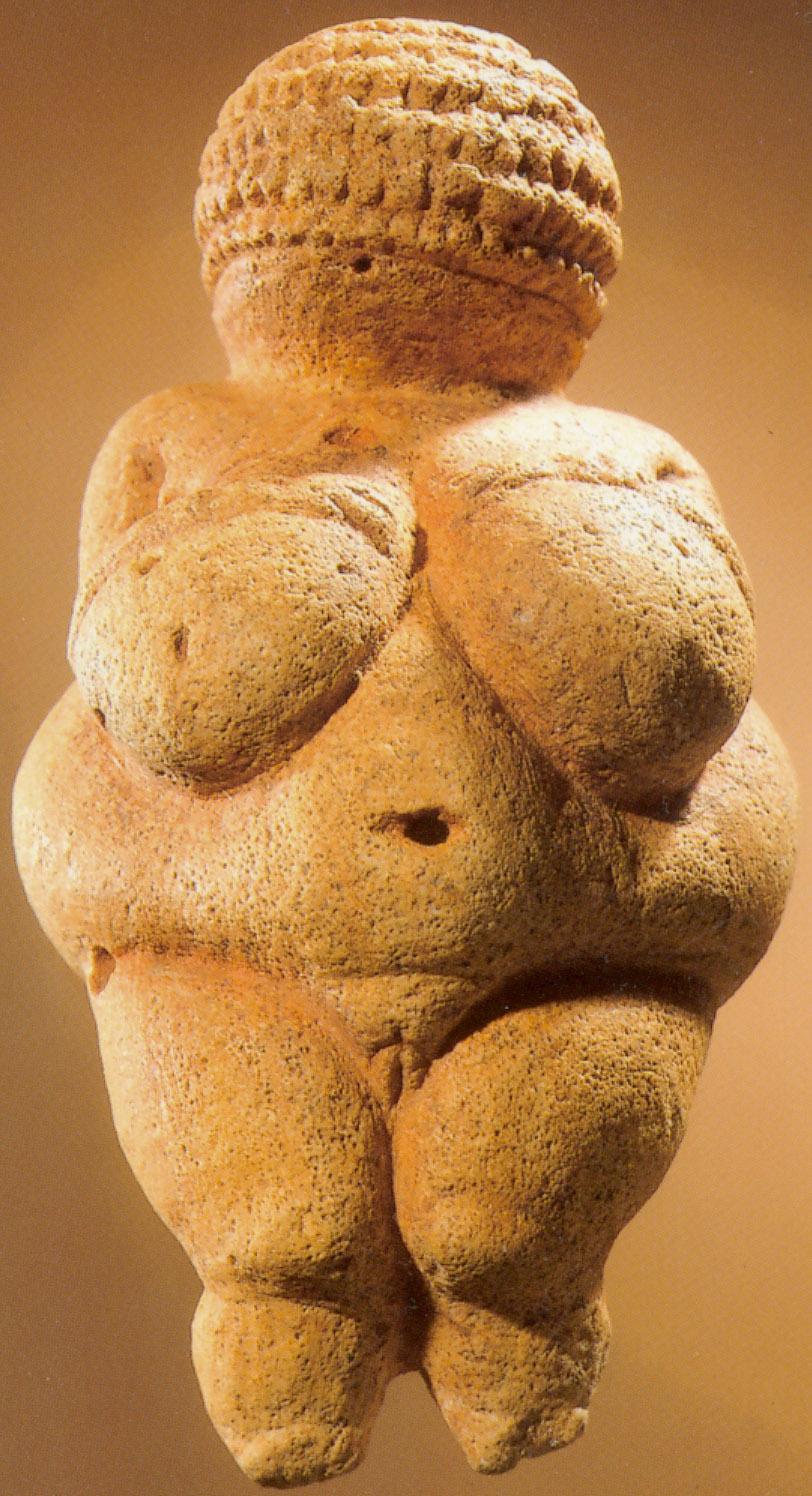
That's why one of my greatest treasures is an exact museum copy of the Venus of Willendorf given to me by a professor friend. Granted, she's not much to look at,

but what amazes me about her is how she fits in the hand. When you hold her, she cradles into the palm and your fingers fit precisely in what would have been the wet clay of her back.  But not just any hand fits. Venus fits comfortably in a small hand, like the hand of a woman. No man who has picked her up says she nestles within his fingers, but every women holds her and for a moment, there is a flicker of recognition that this figurine was probably made by another woman.

That's the sort of thing that I find extremely cool...and yes, funner!